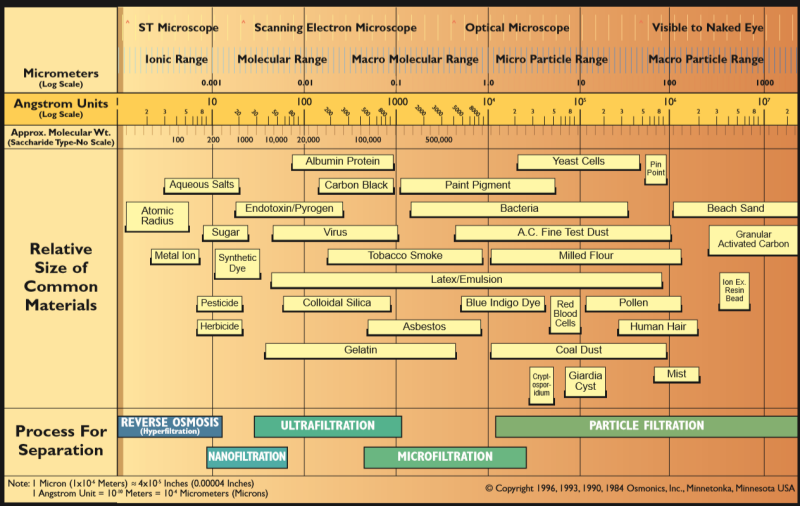
Particle Size Chart for Industrial Filtration
Properly sizing your filtration system is critical for protecting downstream equipment and ensuring product quality. Below, you will find our standard conversion references to help you translate between US Mesh, Microns, Inches, and Millimeters.
Rule of Thumb: Strainers vs. Filters
Generally, particle retention larger than 40 microns (325 mesh) is considered "straining" (coarse filtration), while retention finer than 40 microns falls into the category of "filtering" (fine filtration).
Mesh to Micron Conversion Table
Use this data table to specify the correct screen or element size for your application.
| Retention Type / US Mesh |
Microns (µm) |
Inches (in) |
Millimeters (mm) |
| Coarse Filtration / Perforations |
| 1/2" Perforation | 12,700 | 0.500 | 12.700 |
| 1/4" Perforation | 6,350 | 0.250 | 6.350 |
| 1/8" Perforation | 3,175 | 0.125 | 3.175 |
| 1/16" Perforation | 1,587 | 0.0625 | 1.587 |
| 1/32" Perforation | 794 | 0.0312 | 0.794 |
| Standard Wire Mesh Range |
| 4 Mesh | 4,760 | 0.1870 | 4.760 |
| 8 Mesh | 2,380 | 0.0937 | 2.380 |
| 10 Mesh | 2,000 | 0.0787 | 2.000 |
| 20 Mesh | 841 | 0.0331 | 0.841 |
| 30 Mesh | 595 | 0.0234 | 0.595 |
| 40 Mesh | 420 | 0.0165 | 0.420 |
| 50 Mesh | 297 | 0.0117 | 0.297 |
| 60 Mesh | 250 | 0.0098 | 0.250 |
| 70 Mesh | 210 | 0.0083 | 0.210 |
| 80 Mesh | 177 | 0.0070 | 0.177 |
| 100 Mesh | 149 | 0.0059 | 0.149 |
| 140 Mesh | 105 | 0.0041 | 0.105 |
| 200 Mesh | 74 | 0.0029 | 0.074 |
| 230 Mesh | 63 | 0.0025 | 0.063 |
| 270 Mesh | 53 | 0.0021 | 0.053 |
| 325 Mesh | 44 | 0.0017 | 0.044 |
| 400 Mesh | 37 | 0.0015 | 0.037 |
| Ultra-Fine / Micro-Filtration Range |
| Ultra-Fine (No Mesh Equiv.) | 25 | 0.0010 | 0.025 |
| Ultra-Fine (No Mesh Equiv.) | 15 | 0.0006 | 0.015 |
| Ultra-Fine (No Mesh Equiv.) | 10 | 0.00039 | 0.010 |
| Ultra-Fine (No Mesh Equiv.) | 5 | 0.00020 | 0.005 |
| Ultra-Fine (No Mesh Equiv.) | 2 | 0.00008 | 0.002 |
| Ultra-Fine (No Mesh Equiv.) | 1 | 0.00004 | 0.001 |
Not sure which retention size your system requires?
Our engineering team can help you select the exact strainer or filter based on your fluid type, flow rate, and target particle size.
Request Engineering Assistance
Relative Particle Size Spectrum
Visual comparison of common materials across the filtration spectrum.