
SPEED
EASY NAVIGATION
QUICK RESPONSES
DIRECT SHIPMENTS
GLOBAL SUPPORT
EXCELLENCE
QUALITY SUPPLIERS
PROMPT SERVICE
SATISFACTION IS
#1 PRIORITY
ECONOMICS
LOWEST PRICES
FREE FREIGHT
QUICK DELIVERIES
KNOWLEDGE
FACTORY TRAINED
OTJ EXPERIENCE
ENGINEERING SUPPORT
Automatic Strainers and Filtration Systems
Self-cleaning strainers and filters shipped directly from the factory
An automatic strainer purges retained solids without removing the basket or element. Cleaning is done by flushing, backwashing, or mechanical scraping, so the pipeline stays in service and operators do not open the housing for routine cleaning.
These systems reduce the labor and product loss of manually cleaned simplex strainers, duplex strainers, and bag filters. Factory Direct Pipeline Products supplies flushing basket strainers, backwashing basket strainers, mechanically cleaned strainers, tubular backwashing filters, and multiplexed systems for industrial, petrochemical, and food processes. The designs below are listed in order of increasing cost and application complexity.
Speak with an application sales engineer for sizing, materials, and factory-direct pricing.
Call 908.362.9981Direct shipment from the manufacturer. Proposals typically within 1 business day.
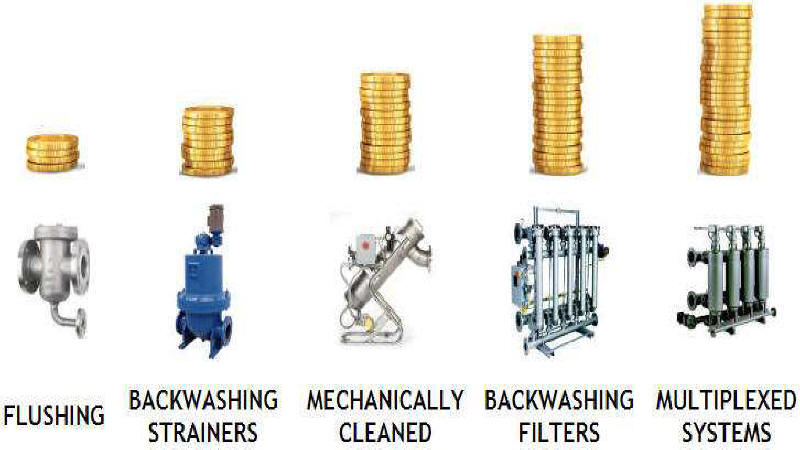
Self-cleaning filtration systems, ordered from lower cost to more specialized designs.
Flushing Basket Strainers
A modified simplex strainer with a drain port at the bottom of the basket. Opening the drain valve flushes retained particles. Cleaning depends on system differential pressure versus atmospheric pressure at the drain, and it works best with hard, non-deformable particles. Built from modified cast strainers, this is the low-cost, short-lead-time way to cut manual cleaning.
Backwashing Basket Strainers
A rotating internal nozzle diverts about 5 percent of already strained fluid back through the screen and out the drain. A cycle typically lasts 3 to 5 minutes. These units cover pipeline sizes from 2 inches to 48 inches and are used mainly on water, where the backwash volume is acceptable. They replace duplex strainers when baskets are too large or heavy to pull by hand, and at sites with limited personnel.
Mechanically Cleaned Strainers
Pioneered by Ronningen-Petter, now an Eaton brand, for non-water liquids, high-viscosity fluids, and processes where product loss must stay low. Typical fluids include paint, wax, petroleum products, and food and beverage streams. A disc wipes the element and drives solids into a bottom purge chamber. System pressure then dumps the chamber. The cycle takes less than 1 second and uses less than 1 gallon of fluid. Stroke and purge timing are set on programmable timers. Models include DCF-400, DCF-800, DCF-1600, DCF-2000, DCF-3000, MCS, and MCF.
Tubular Backwashing Filter Systems
Also pioneered by Ronningen-Petter, for retentions down to the 1 to 3 micron range. Flow is reversed through one element at a time and solids go to drain. Parallel chambers keep downstream flow and discharge pressure steady while a station cleans. AFR housings use 4 to 8 chambers in a compact body. AFC systems place multiple housings on shared inlet, outlet, and drain manifolds.
Multiplexed Systems
Several automatic strainers or filters on one pipeline, run from a single master panel. Shared inlet, outlet, and drain manifolds support high flow, heavy solids loading, and viscous fluids. Multiplexed AFC and AFR tubular systems and large MCS units reach thousands of GPM.
Automatic Strainer Comparison
| Design | Cleaning method | Best used for | Product loss |
|---|---|---|---|
| Flushing basket strainer | Open drain under the basket | Hard, non-deformable particles; low cost | Drain volume only |
| Backwashing basket strainer | Rotating nozzle reverses about 5% of flow | Water; 2 in. to 48 in. pipelines | About 5% of flow for 3 to 5 minutes |
| Mechanically cleaned strainer | Disc wipes element into a purge chamber | Viscous, hazardous, or high-value fluids | Under 1 gallon in under 1 second |
| Tubular backwashing filter | Reverse flow through one chamber | Fine retention, 1 to 3 microns, continuous flow | Isolated chamber only |
| Multiplexed system | Same methods, shared manifolds | High GPM, heavy solids, viscous fluids | Depends on the strainer type |
Frequently Asked Questions
What is an automatic strainer?
An automatic strainer purges retained solids without removing the basket or element. Cleaning is by flushing, backwashing, or mechanical scraping, so the line stays in service.
What is the difference between backwashing and mechanically cleaned strainers?
Backwashing uses a small amount of clean fluid to reverse flow through the screen. It suits water. Mechanically cleaned strainers wipe debris into a purge chamber with almost no product loss. They suit viscous or hazardous fluids. See backwashing vs mechanically cleaned strainers.
When should a flushing basket strainer be used?
Use one for hard, non-deformable particles when a modified simplex strainer is enough. Opening the drain under the basket flushes the solids. Effectiveness depends on differential pressure versus the drain.
Which system handles the highest flow rates?
Backwashing basket strainers cover 2 inch to 48 inch lines. Multiplexed AFC and AFR tubular systems and large MCS units handle thousands of GPM on common manifolds under one panel.
How much product is lost during cleaning?
Backwashing basket strainers divert about 5 percent of flow for 3 to 5 minutes. Mechanically cleaned strainers purge in under 1 second and use less than 1 gallon. Tubular systems isolate one chamber so downstream flow continues.
Technical Resources and Application Sizing
Design overview: automatic filtration system designs. Comparison article: backwashing vs mechanically cleaned strainers. Flushing primer: what is a flushing strainer?
Submit pipeline specifications on the application inquiry form. Engineering returns a system proposal within 1 business day. Or call 908.362.9981.